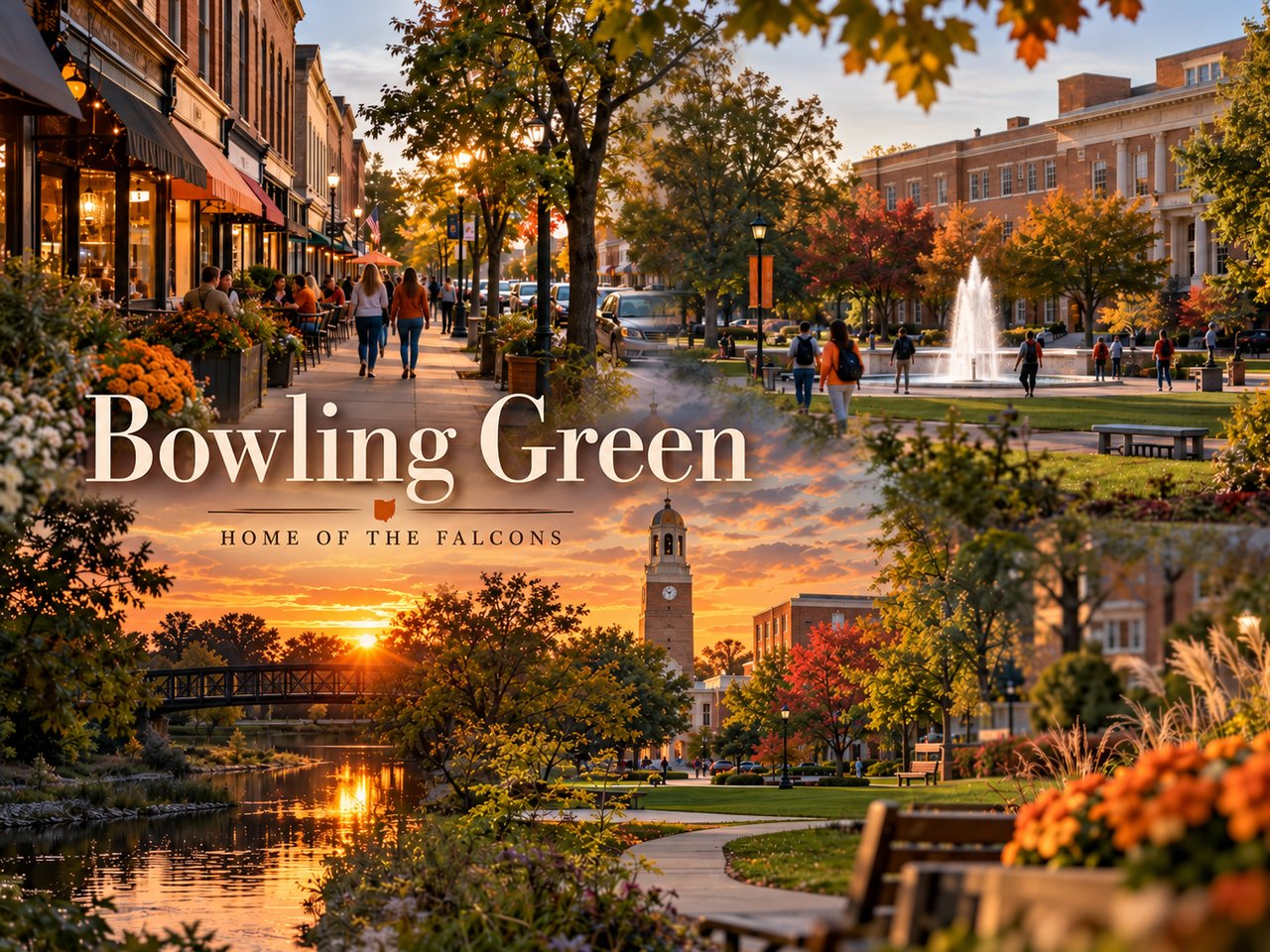
Thinking about moving to Bowling Green, Ohio?
Bowling Green is a lively college town of about 30,000 in Wood County, home to Bowling Green State University and a walkable historic downtown, roughly 25 minutes south of Toledo on Interstate 75. It pairs university-town energy and highly rated schools with genuine Midwestern affordability. As of fall 2026, a typical Bowling Green home sells for around $280,000 to $300,000, strong value for a community with this much going on.
I'm Cail Courtney, a Realtor with The Danberry Co., serving Bowling Green and the wider Northwest Ohio market. This guide is the honest version of the conversation I have with buyers considering Bowling Green: what living here actually looks like, what it costs, and how to decide if it's the right fit.
Why do people move to Bowling Green, Ohio?
People move to Bowling Green for a combination that's rare in a town this size: a real university-town atmosphere, a charming historic downtown, highly rated schools, and easy access to Toledo. Four things drive most of my buyers here.
A genuine college town. Bowling Green State University anchors the community, bringing Falcons athletics, concerts, theater, lectures, and a steady cultural energy that keeps the town lively and active. You get access to big-university amenities while living in a small, welcoming city.
A walkable historic downtown. Bowling Green's Main Street is a true downtown, with local restaurants, coffee shops, breweries, and independent shops, plus year-round events. It has the kind of character and walkability that newer suburbs can't replicate.
Highly rated schools. Bowling Green City Schools earned a 4.5-star overall rating, a mark the state describes as exceeding standards, on the most recent Ohio School Report Card. For many buyers, the district is a major reason to look here.
Affordability with location. Bowling Green offers college-town amenities at Midwestern prices, and it sits right on I-75 for an easy commute to Toledo and beyond. You get a lot of community and convenience for the money.
Put those together and you get Bowling Green's real pitch: the culture and schools of a place you'd expect to pay a premium for, in an affordable, walkable town on the interstate.
Where is Bowling Green, and how connected is it?
Bowling Green is the county seat of Wood County, sitting directly on Interstate 75 in Northwest Ohio. That location is one of its biggest practical advantages.
You're about 25 minutes south of downtown Toledo, which puts big-city jobs, healthcare, culture, and sports within an easy commute, while you come home to a quieter college town. Two international airports are within reach: Toledo Express is roughly 30 minutes away, and Detroit Metropolitan (DTW) is a little over an hour north. Columbus, Dayton, and Detroit are all comfortable day trips. One distinctive local feature you'll notice right away: the wind turbines along I-75 near town, a small but memorable part of the Bowling Green landscape.
What is the cost of living and housing market in Bowling Green?
Bowling Green is an affordable market overall, and a strong value given what the town offers. Housing is the biggest driver of cost-of-living differences between communities, and Bowling Green's sits comfortably below many comparable university towns.
Here's what the local market actually looks like as of fall 2026, based on MLS data for residential homes in Bowling Green:
- Typical sale price: Median sold prices have generally run in the $260,000 to $305,000 range through 2026, with a typical home landing around $280,000 to $300,000.
- How fast homes sell: Homes are averaging about 50 days on the market, a healthy, balanced pace.
- How much is for sale: Active inventory is lighter than in larger nearby markets, often around 40 to 50 homes at a time, so well-priced, move-in-ready homes tend to attract steady interest.
Because inventory here runs lean, being ready to move when the right home appears matters more than in a market flush with listings. One note specific to a college town: Bowling Green has an active rental and investment segment tied to the university, so it helps to be clear on whether you're shopping for a primary home or an investment property, since they compete for different listings.
(Market conditions shift month to month. If you want current numbers for a specific price range or neighborhood, I pull live MLS data, just reach out.)
What about the Meta data center coming to Wood County?
A roughly $800 million Meta data center is under construction in Middleton Township, just north of Bowling Green, and it has become one of the most talked-about and most debated developments in the area. If you're researching a move here, you've probably already seen the headlines, so here is an honest look at both sides.
On the potential upside, the project is expected to broaden the local tax base over time, supporting schools, the township, and the county. Local reporting puts it at about 100 permanent jobs, with an average salary around $83,000 according to JobsOhio, plus more than 1,000 construction workers at peak, along with the vendor and supplier activity a project this size tends to bring. Attracting a company of Meta's scale is also a signal that Wood County is seen as a serious place to invest.
The concerns raised by residents and local advocates are real and worth understanding too. A separate 350-megawatt gas-fired power plant was approved to help power the facility, and critics have raised air-quality and emissions concerns, along with frustration that it moved forward with limited public hearings. The facility's demands on water and electricity have prompted worry about effects on local utility rates, and the water supply draws on Bowling Green's system. Many residents were also frustrated by how little public input there was during zoning and planning, some of which happened under non-disclosure agreements. And some question whether roughly 100 permanent jobs justify the 75% tax abatement, approved for 15 years, that the project received. Meta, for its part, has said its water use will be minimal and has promoted its local investment, though some of its public claims have been disputed by local officials and covered closely in the local press.
What does it mean if you're buying here? Honestly, it is too early to know the net effect on home values. A major employer and a larger tax base can support housing demand and local services, while proximity to industrial infrastructure, added construction traffic, or higher utility costs may matter to some buyers, especially in the northern part of the county nearest the site. My job is to give you the full picture, not to spin it. If you're considering a home in that area, I'm glad to talk through the specifics and point you to the local coverage so you can form your own view.
What are the schools like in Bowling Green?
Bowling Green City Schools is one of the stronger districts in the region, earning a 4.5-star overall rating on the Ohio School Report Card, which the state classifies as exceeding standards. Because school reputation is closely tied to demand and to home values, the district is a common starting point when buyers decide where to look.
Higher education is woven right into the town. Bowling Green State University offers a respected four-year institution a few minutes from most neighborhoods, and the University of Toledo is a short drive north, so college options are unusually close.
If schools are central to your decision, tell me early. I can point you toward the neighborhoods and price points that fit your needs, which saves a lot of wasted searching.
What is there to do in Bowling Green?
Day to day, Bowling Green lives bigger than its size:
- University life: BGSU athletics, concerts, theater, and campus events, most open to the community.
- Historic downtown: A walkable Main Street with local restaurants, breweries, coffee shops, and independent retail.
- Festivals and events: The Black Swamp Arts Festival brings art, music, and crowds downtown each fall, and the Wood County Fair is a long-running summer tradition.
- The outdoors: Community parks, trails, and the wide-open Wood County countryside, with Toledo's Metroparks a short drive away.
It's the kind of town where you can catch a Falcons game, browse a historic downtown, and grab dinner at a local spot, all in the same afternoon.
Is Bowling Green, Ohio a good place to live?
For the right buyer, yes, and the profile is fairly consistent. Bowling Green tends to appeal most to buyers who value a walkable downtown and university-town energy, who want highly rated schools, who appreciate quick access to Toledo without living in the city, and who are looking for strong value in an established, in-demand community.
No place is perfect for everyone. Bowling Green's lean inventory means the right home can take some patience, and the university influence gives the market its own rhythm. That's exactly the kind of thing I help buyers think through.
Not sure Bowling Green is the one? I serve communities across Northwest Ohio, each with its own feel and price point. You can explore the other areas I cover here, including Findlay to the south and Perrysburg toward Toledo. And if you're weighing the timing of a purchase, my guide to what today's mortgage rates mean for Northwest Ohio buyers is a good place to start. Tell me your budget and must-haves, and I'll help you find the right community, not just the right house.
Frequently asked questions about Bowling Green, Ohio
Is Bowling Green, Ohio a good place to live? Yes, Bowling Green is consistently popular for its university-town atmosphere, walkable historic downtown, highly rated schools, and affordability, all about 25 minutes from Toledo. It's an especially good fit for buyers who want culture and strong schools without a big-city price tag.
How much does a house cost in Bowling Green? As of fall 2026, a typical Bowling Green home sells for around $280,000 to $300,000, with median sold prices running roughly $260,000 to $305,000 through the year. That's strong value for a college town with highly rated schools.
How are the schools in Bowling Green? Bowling Green City Schools earned a 4.5-star overall rating, described by the state as exceeding standards, on the most recent Ohio School Report Card, placing it among the stronger districts in the region.
How far is Bowling Green from Toledo? Bowling Green is about 25 minutes south of downtown Toledo via I-75. Toledo Express Airport is roughly 30 minutes away, and Detroit Metropolitan (DTW) is a little over an hour north.
What is Bowling Green known for? Bowling Green is known for Bowling Green State University, its walkable historic downtown, the annual Black Swamp Arts Festival, and the wind turbines along I-75. It blends college-town energy with small-city affordability.
Is a Meta data center being built near Bowling Green? Yes. A roughly $800 million Meta data center is under construction in Middleton Township, just north of Bowling Green. Supporters point to a broader tax base and about 100 permanent jobs plus construction work, while residents have raised concerns about a new gas-fired power plant, water and electricity demands, utility rates, and the project's tax abatement. It's a developing, closely watched local story.
Ready to explore a move to Bowling Green?
I'm Cail Courtney with The Danberry Co., and helping people relocate to Bowling Green and across Northwest Ohio is what I do. If you're weighing a move, even if it's months away, I'm happy to answer questions, send you current listings in your price range, and put together a personalized relocation snapshot for your situation.
Reach out anytime: 📞 419-307-0524 ✉️ [email protected] 🌐 cailcourtney.com
Let's find out if Bowling Green is the right move for you.
Cail Courtney is a licensed real estate agent with The Danberry Co., serving Bowling Green and Northwest Ohio. Market figures cited are drawn from local MLS data as of fall 2026 and are provided for general information; they are not a market appraisal or financial advice.